Glaucoma Care Services
Glaucoma is one of the leading causes of permanent vision loss in the world, and it is often called the “silent thief of sight” because it can progress without any early warning signs. The good news is that when glaucoma is found early and managed properly, most people are able to keep their vision for life. Our department, led by Dr. Tanvi Choudhary, is dedicated entirely to the diagnosis and treatment of glaucoma, and we offer every level of care under one roof — from routine eye examinations and cataract care to the most advanced glaucoma surgeries available today.
Whether you have just been told you may have glaucoma, you have been living with the condition for years, or your case has not responded to earlier treatment elsewhere, our team is equipped to help. Below is a detailed look at the glaucoma services we provide:
1. Glaucoma Diagnostics
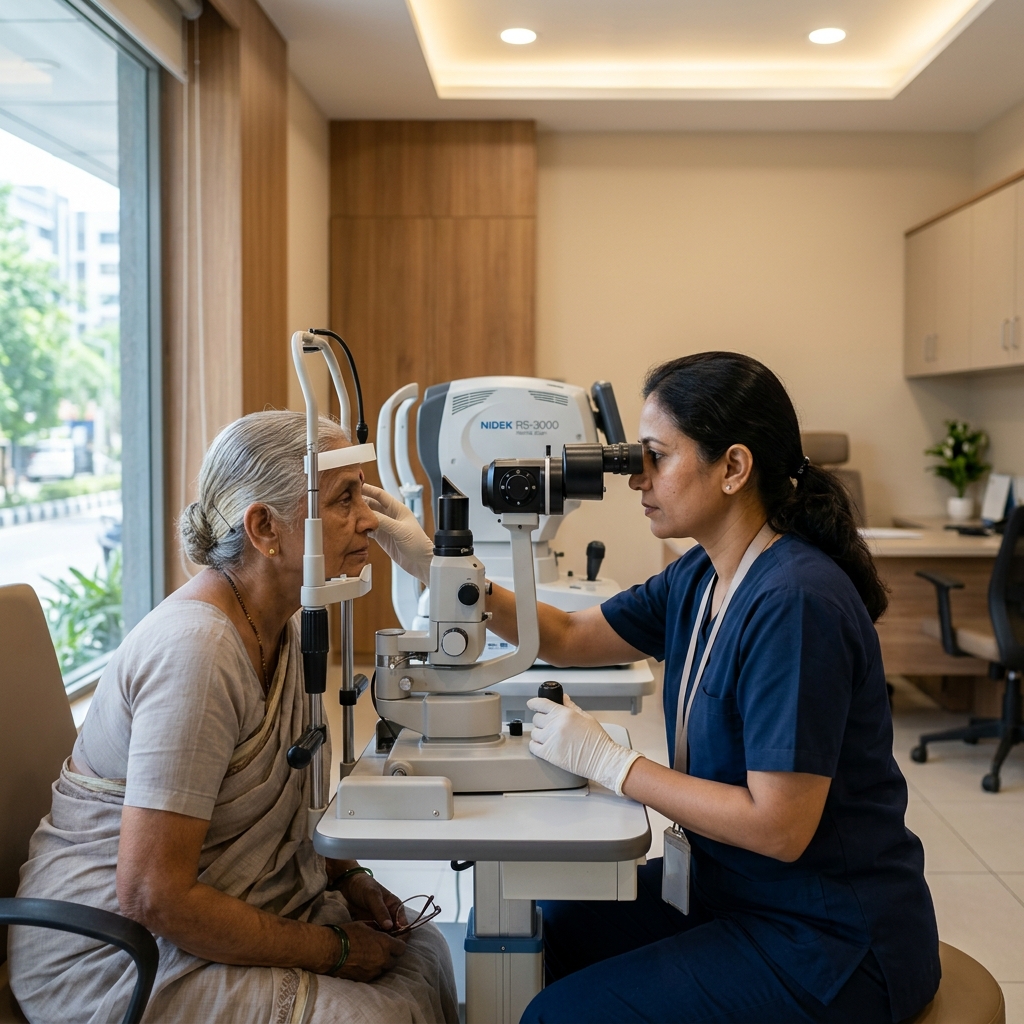
Accurate diagnosis is the foundation of good glaucoma care. We use a full range of advanced, painless tests to examine the health of the optic nerve, measure eye pressure, and track even the smallest changes in vision over time. We do not rely solely on puff-tonometry, which is often inaccurate. Our diagnostic tools include:
- Applanation tonometry: The gold-standard method for measuring the pressure inside the eye, calibrated directly on the slit lamp (Goldmann Applanation Tonometry).
- Pachymetry: Measures the thickness of the cornea, which helps us interpret and correct eye pressure readings accurately.
- Gonioscopy: A special mirror lens examination that allows us to view the drainage angle of the eye directly and classify Open vs. Closed angle profiles.
- Optical Coherence Tomography (OCT): A detailed, high-resolution scan (Spectral-Domain OCT) that captures the fine structure of the optic nerve head and retina to detect nerve fiber layer thinning at its earliest pre-symptomatic stages.
- Fundus photography: High-resolution digital photographs of the back of the eye, used to document, archive, and monitor the optic nerve cup-to-disc ratio over time.
- Perimetry (Zeiss HFA 3 840i): A visual field test that maps your side (peripheral) and central vision sensitivity to detect, map, and track any vision loss caused by glaucoma.
Together, these tests allow us to diagnose glaucoma early, confirm exactly which type is present, and monitor patients closely so that treatment can be adjusted before significant vision is lost.
2. Glaucoma Care for Children and Adults
Glaucoma is not only a disease of older adults — it can also affect infants, children, and young people, sometimes from birth. We provide dedicated care for glaucoma at every age, including congenital and childhood glaucoma, as well as the more common forms that develop later in life.
Because a child’s eyes are still growing and children cannot always describe their symptoms, we use age-appropriate examination techniques (including examination under anesthesia when necessary to save vision and prevent corneal enlargement) and follow-up schedules to catch problems early and protect vision through every stage of growth.
3. Complex and Refractory Glaucoma Management
Some cases of glaucoma are difficult to control, either because the eye pressure remains high despite treatment, because there are other eye conditions present at the same time (such as trauma, steroid eye drops usage, uveitis inflammation, or neovascularization secondary to diabetic retinopathy), or because previous surgery has not given lasting results. These are known as complex or refractory cases.
We specialise in taking on such difficult cases, carefully reviewing each patient’s full history, and building a tailored treatment plan that may combine medication, laser, and surgical options to bring the disease under control.
4. Lasers for Glaucoma
Laser treatment is often a safe, effective, and minimally invasive way to control eye pressure, either as a first-line treatment or alongside medication. Depending on the type and stage of glaucoma, laser therapy can help improve the drainage of fluid from the eye or reduce the amount of fluid the eye produces. These procedures are typically quick, performed in the clinic, and involve little to no downtime for the patient. We offer:
5. Conventional Glaucoma Surgeries
When medication and laser treatment are not enough to control eye pressure, surgery may be recommended. We offer well-established, time-tested surgical procedures, including:
- Trabeculectomy with Mitomycin C: A filtering surgery that creates a new drainage channel (bleb) under the eyelid for fluid to leave the eye, helping to lower pressure long-term. Mitomycin C, used during the procedure, helps prevent scarring to keep the new drainage channel working effectively.
- Trabeculotomy with Trabeculectomy: A combined procedure often used in congenital and childhood glaucoma, which opens the eye’s natural drainage system while also creating an additional outflow path.
6. Advanced Glaucoma Surgeries
For patients who need more specialised surgical approaches — whether due to the type of glaucoma, previous surgery, or a preference for less invasive options — we offer advanced techniques, including:
- Non-Penetrating Deep Sclerectomy: A technique that lowers eye pressure without fully opening the eye's anterior chamber, which can mean a lower risk of certain complications compared to conventional surgery.
- Ahmed Glaucoma Valve: A small drainage valve device implanted in the eye to provide a controlled, ongoing, valved pathway for fluid to drain, used especially in more difficult, neovascular, or previously operated cases.
7. Newer Implant Surgeries
Glaucoma drainage device technology continues to advance, and we offer some of the newest implant options available, including:
- Aurolab Aqueous Drainage Implant (AADI): A large-plate non-valved drainage device designed to manage high eye pressure in complex and refractory cases where other treatments have not succeeded.
- Paul Glaucoma Implant: A newer-generation, low-profile drainage device made of flexible silicone, designed to provide effective, sustained pressure control with a slim design intended to improve comfort and reduce surgical risks.
8. Micro-Invasive Glaucoma Surgery (MIGS) & Cataract Services
MIGS refers to a group of modern surgical techniques designed to lower eye pressure through very small incisions, with less tissue disruption than traditional glaucoma surgery. These procedures generally offer a quicker recovery and a strong safety profile, making them a good option for suitable patients, including those with mild to moderate glaucoma or those undergoing cataract surgery at the same time.